Every year, Poland welcomes hundreds of thousands of new residents: professionals, entrepreneurs, families. Today, over 2 million foreigners live in the country, building their lives, careers, and futures here. They chose Poland for opportunity, stability, and growth. Moving to a new place means building a new life in an environment you don’t fully control. As an expat, you rely on systems that are not familiar — especially healthcare.
For expats, reliance on healthcare systems often feels manageable in daily life, especially when nothing urgent is happening and access appears straightforward. Registration is complete, procedures seem clear, and the assumption is that care will be available when needed. However, in moments of illness, urgency, or national crisis, access “on paper” offers little reassurance. What truly matters is the certainty of having a secure place in a system that does not fall under the pressure. This is exactly where the limitations of public healthcare become clear and the value of private medical insurance emerges. A sudden health issue, unexpected visit at the ER, recommendation to see a specialist. At this moment you need to makes sure that you have “Reserved Seat” in the system.
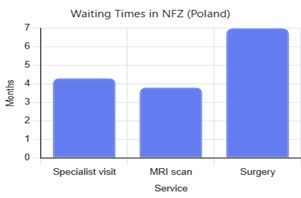
Data from the Polish NFZ system illustrates this reality clearly. Even in stable conditions, waiting time for a specialist visit and MRI scans are measured in months, while surgery often requires the longest wait. These delays are not exceptional — they are structural.
This is where private medical insurance becomes relevant — not as a replacement for public healthcare, but as a strategic layer of protection that removes a key concern for expats: the risk of uncertainty or rejection by local hospitals when healthcare systems are under pressure during a crisis
Private Healthcare Use by Expats in Poland
- 80%–100% of expats choose private healthcare as a supplement rather than relying solely on NFZ (public healthcare)
- Private healthcare is popular for faster access to specialists, modern infrastructure, and English-speaking medical staff, crucial for expats
- The majority of expats and international professionals in Poland choose private health insurance plans, typically ranging from €120 to €250+ per month, depending on coverage level
For expats, the difference between public and private health care is particularly significant. Without long‑established knowledge of local procedures, informal pathways, or personal networks, even small disruptions can lead to uncertainty. Questions arise quickly: Where should I go? How long will I wait? Will I be accepted at all? Will I be able to communicate? In healthcare, these questions carry weight — because time and access matter.
The Only Real Safety Net in a Difficult Times
A national crisis fundamentally changes how healthcare systems operate. Hospitals become overwhelmed, resources are stretched, and access is no longer guaranteed for everyone. In such conditions, prioritisation replaces predictability, and waiting often replaces certainty. For expats, this means uncertainty about whether they will be accepted, how long they will have to wait, or where to turn next.
Private medical insurance removes that uncertainty. It ensures that you are not left navigating an overloaded system or wondering whether care will be available when you need it most. By securing access in advance, it gives you something essential during a crisis: a reserved seat in the system, even when demand exceeds capacity. When public system is under strain, private care continues to function. It stays open, predictable, and accessible.
Individual health private insurance is not a matter of comfort or preference. It is the only reliable way to guarantee your safety and continuity of care during a national crisis.
Secure your access. Secure your peace of mind in the face of uncertainty.
Sources:
1. Statistics Poland (GUS) – data on foreigners working in Poland (2025)
2. National Health Fund (NFZ) – official data on healthcare access and waiting times